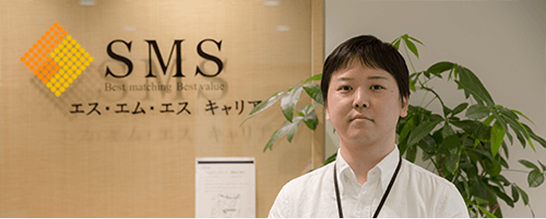
CRM Group, Media Planning Department
Mr. Tsutomu Oishi
Services you can use
SMS Connect (Web Management Screen/API)
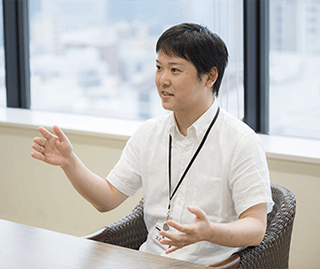
--Could you tell us about the business activities of SMS Group and SMS Career?
The SMS Group's mission is to "continue to contribute to society by creating value through the construction of information infrastructure suitable for an aging society," and its overall business involves building information infrastructure in the fields of nursing care, medical care, careers, healthcare, and senior life.
Within this, SMS Career, under the slogan "Energizing those working in medical care and nursing care, and energizing Japan," aims to contribute to the continued provision of high-quality medical and nursing care services in Japan by building information infrastructure that alleviates the shortage of personnel in the medical and nursing care fields.
—Is there a lack of information infrastructure in fields such as healthcare and nursing care?
I feel that information provision is still insufficient in the fields of healthcare and nursing care. For example, when recruiting nurses, the recruitment information posted on hospital websites often only includes employment conditions. As a result, nurses who are looking for information they need to know before actually working there, such as the facility's equipment and the voices of people who are already working there, are not available before changing jobs. I've heard that this can lead to nurses leaving their jobs soon after being hired. That's a real waste. This is just one example, but we believe that our mission is to solve the shortage of healthcare and nursing care workers by providing an information infrastructure—a system that properly delivers the information that job seekers need
--SMS Career provides recruitment services in many medical and nursing care fields
I work in CRM for "Nurse Talent Bank," a recruitment service specializing in nurses. I provide information to registered job seekers via phone, email, and SMS.
As a service, the most important thing is to get as many people as possible to register. If I may say so myself, I believe we have the largest number of registered nurses in the industry. However, since the ultimate goal of our registered users is to find a new job, communication is just as important as registration. Our registered users range from those who "just quit their job yesterday and want to change jobs immediately" to those who "are just doing some research." The frequency and intensity of communication that each registered user desires varies, so we emphasize TPO (Time, Place, and Occasion).
In other words, TPO means "being able to communicate at the right time, through the right means, and with the right content." I believe that this is fundamental and extremely important.
—Could you tell us what prompted you to introduce short messages (SMS)?
While we use various methods of communication with registered users until they ultimately find a new job, such as face-to-face meetings, phone calls, and emails, we are always looking to increase the number of methods that are consistently effective. One method we have been considering is short messaging (SMS)
—How do you feel about the differences between short messages (SMS) and other means of communication?
The biggest difference is probably the higher likelihood of the message being noticed. Job seekers often register with multiple services, so they likely receive numerous phone calls and emails not only from our company but also from other companies. However, whether these are appropriate for the registered user's time, place, and occasion is a bit of a challenge. In such situations, short messages (SMS) are just as likely to be noticed as phone calls, yet they can be read at the registered user's convenience, thus achieving appropriate timing and context. Looking at the click-through rate of URLs sent via short messages (SMS), I feel they are read more often than emails. It's a different case, but when
I send an email to my boss, I don't get a reply for a long time, but when I send a short message (SMS), I get a response immediately (laughs). The fact that the number 1 appears on the mobile phone screen means that it's easy to notice.
However, simply getting noticed isn't enough; I also feel it's important to provide multiple ways for users to read the message and take action. I want to offer several methods that allow registered users to act without feeling stressed, such as being able to make a phone call or access the site via the web
—How do you differentiate between and combine the use of short messages (SMS) and other means of communication (face-to-face, phone, email)?
If you consider which has a lower psychological barrier—answering a phone call or clicking a URL in a text message (SMS)—I think clicking the URL is probably lower. For example, to confirm whether someone is interested in a job posting or has the intention to change jobs, a text message (SMS) seems suitable. On
the other hand, to confirm deeper aspects such as what kind of work style they prefer or whether they will apply for a job, face-to-face or phone calls are effective. There are things you can only understand by talking directly, such as their demeanor and the state of their voice.
Also, when sending information periodically to people who are not currently looking for a job, we use email. As I mentioned earlier, emails are becoming less likely to be read, but unlike text messages (SMS), emails have no character limits and can be sent regularly without burdening the recipient. We use email, text messages (SMS), and phone calls (face-to-face) depending on the situation of our registered users.
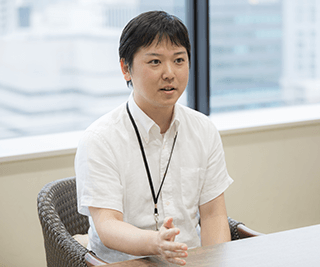
—How has your work changed since implementing Acrite SMS?
At Nurse Job Bank, registering your mobile phone number is mandatory, but registering your email address is not. The ability to contact everyone at once using short messages (SMS), regardless of whether they have registered their email address or not, is very effective. For example, comparing calling 10,000 people individually with sending 10,000 short messages (SMS) to all 10,000 people at once, short messages (SMS) are far more efficient. It offers significant advantages in terms of both operator time and cost
Another useful feature is the ability to send a short message (SMS) when it's too late to make a phone call at night but you need to contact someone urgently
—Were there any concerns you had before sending the short message (SMS)?
While we couldn't predict the actual reactions beforehand, and therefore didn't have any strong concerns, we did consider the possibility of a certain number of negative responses. In reality, it was more well-received than expected. Of course, we made efforts within the PDCA cycle to avoid complaints, but I believe that sending information via short message (SMS) to people who already register on job search sites is not inherently offensive
--Could you tell us why you chose our company to implement your short message (SMS) delivery service?
At our company, we thoroughly implement the PDCA cycle whenever we introduce a new initiative. We implement an initiative, identify its problems, and then implement an improved version. We continue to apply the PDCA cycle to how we use short messages (SMS) even now.
Initially, we were using a service other than Acrite for our short message (SMS) delivery service. However, as we continued to apply the PDCA cycle, we wanted to communicate our needs, but that company made it difficult. What made Acrite different was that we could have regular meetings and exchange opinions. Furthermore, Acrite incorporated our feedback and continued to improve their service, making it much easier to use now compared to when we first implemented it. We are very grateful that we were able to work together with them.
--We are very grateful for your feedback from the perspective of actual business use. Other customers have also praised the improved ease of use of the management screen
--Finally, could you tell us about your aspirations for the future?
I am drawn to the fact that we are creating industry-leading services from various angles. In the future, I would like to gain experience by creating outstanding services not only in nursing but also in other fields. At the same time, I would like to consider how I can use that experience to address the needs of society
—It's clear that you find your work very fulfilling. Thank you very much